The Safer Affordable Fuel-Efficient (SAFE) Vehicles Rule for Model Years 2021-2026 Passenger Cars and Light Trucks
Federal Register2018-08-24 · DEPARTMENT OF TRANSPORTATION; National Highway Traffic Safety Administration; ENVIRONMENTAL PROTECTION AGENCY · Proposed Rule · 2018-16820
Notice of proposed rulemaking.
The National Highway Traffic Safety Administration (NHTSA) and the Environmental Protection Agency (EPA) are proposing the "Safer Affordable Fuel-Efficient (SAFE) Vehicles Rule for Model Years 2021- 2026 Passenger Cars and Light Trucks" (SAFE Vehicles Rule). The SAFE Vehicles Rule, if finalized, would amend certain existing Corporate Average Fuel Economy (CAFE) and tailpipe carbon dioxide emissions standards for passenger cars and light trucks and establish new standards, all covering model years 2021 through 2026. More specifically, NHTSA is proposing new CAFE standards for model years 2022 through 2026 and amending its 2021 model year CAFE standards because they are no longer maximum feasible standards, and EPA is proposing to amend its carbon dioxide emissions standards for model years 2021 through 2025 because they are no longer appropriate and reasonable in addition to establishing new standards for model year 2026. The preferred alternative is to retain the model year 2020 standards (specifically, the footprint target curves for passenger cars and light trucks) for both programs through model year 2026, but comment is sought on a range of alternatives discussed throughout this document. Compared to maintaining the post-2020 standards set forth in 2012, current estimates indicate that the proposed SAFE Vehicles Rule would save over 500 billion dollars in societal costs and reduce highway fatalities by 12,700 lives (over the lifetimes of vehicles through MY 2029). U.S. fuel consumption would increase by about half a million barrels per day (2-3 percent of total daily consumption, according to the Energy Information Administration) and would impact the global climate by 3/1000th of one degree Celsius by 2100, also when compared to the standards set forth in 2012.
Original sourceXML (2.1 MB)PDF (15.8 MB)
Other documents for the same rulemaking
References: 112 extracted, 36 linked to papers
Page 1Download these results: CSV · JSON
Allcott & Wozny (2014)
journal articleNot linked to a paper · nearest section heading: fuel cost valuation discussion
Busse et al. (2013)
journal articleNot linked to a paper · nearest section heading: fuel cost valuation discussion
Sallee et al. (2016)
journal articleNot linked to a paper · nearest section heading: fuel cost valuation discussion
Mislinski, J. Light Vehicle Sales Per Capita: Our Latest Look at the Long-Term Trend, Advisor Perspectives (June 1, 2018)
Zabritski, M. State of the Automotive Finance Market: A look at loans and leases in Q4 2016, Experian
Fitch Ratings Vehicle Depreciation Report February 2017, Black Book
Michael K. Hidrue, George R. Parsons, Willett Kempton, Meryl P. Gardner, Willingness to pay for electric vehicles and their attributes, Resource and Energy Economics, Volume 33, Issue 3, 2011, Pages 686-705.
Thus, an additional social cost of about $3,500 per vehicle was assigned to the EV150 to capture the lost utility to consumers.\249\ Additionally, NHTSA imposed a ``relative value loss'' of 1.94% of the vehicle's MSRP to reflect the economic value of the difference between the useful life of a conventional ICE and the 150- mile EV when it reaches a 55% battery capacity (as a result of battery deteroriation).\250\ In subsequent analyses (the 2016 Draft TAR analysis and today's analysis), NHTSA removed the low-range EVs from its technology set due to both weak consumer demand for low-range EVs in the marketplace and subsequent technology advances that make 200- mile EVs a more practical option for new EVs produced in future model years.
Gruenspecht (1981)
bookNot linked to a paper · nearest section heading: How Fuel Economy Standards Impact Vehicle Scrappage
Greenspan & Cohen (1996)
journal articleNot linked to a paper · nearest section heading: How Fuel Economy Standards Impact Vehicle Scrappage
Jacobsen & van Benthem (2015)
journal articleNot linked to a paper · nearest section heading: Aggregate vs. Atomic Data Source in the Literature
Bento, Roth, & Zhuo (2016)
journal articleNot linked to a paper · nearest section heading: Aggregate vs. Atomic Data Source in the Literature
Bento et al. (2009)
journal articleNot linked to a paper · nearest section heading: Literature on rebound effect
Barla et al. (2009)
journal articleNot linked to a paper · nearest section heading: Literature on rebound effect
Wadud et al. (2009)
journal articleNot linked to a paper · nearest section heading: Literature on rebound effect
West & Pickrell (2011)
journal articleNot linked to a paper · nearest section heading: Literature on rebound effect
Anjovic & Haas (2012)
journal articleNot linked to a paper · nearest section heading: Literature on rebound effect
Small & Van Dender (2007)
journal articleNot linked to a paper · nearest section heading: Literature on rebound effect
Su (2012)
journal articleNot linked to a paper · nearest section heading: Literature on rebound effect
Linn (2013)
journal articleNot linked to a paper · nearest section heading: Literature on rebound effect
Newell, R. G. & Prest, B.C. The Unconventional Oil Supply Boom: Aggregate Price Response from Microdata, Working Paper 23973, National Bureau of Economic Research (Oct. 2017)
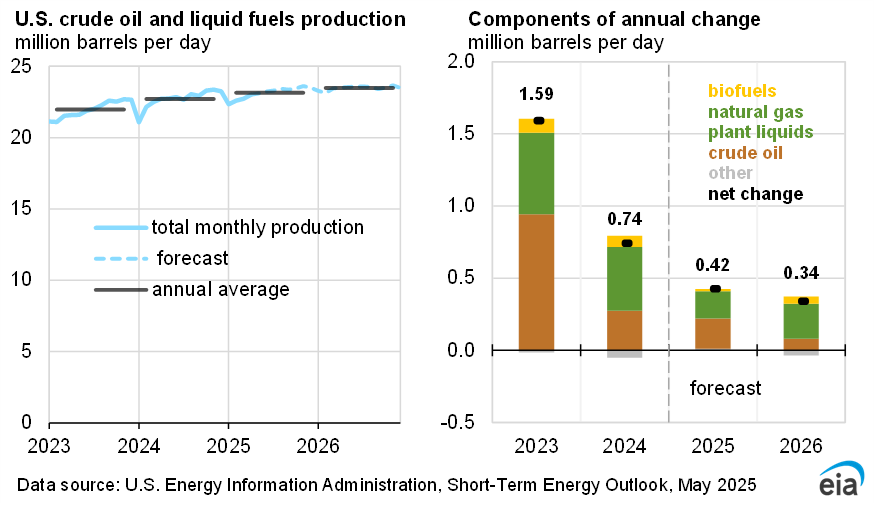
oil production could rise by 0.5 million barrels per day in 6 months, 1.2 million in 1 year, 2 million in 2 years, and 3 million in 5 years.'' \439\ Some analysts suggest that shale drillers can respond more quickly to market conditions because, unlike conventional drillers, they do not need to spend years looking for new deposits, because there are simply so many shale oil wells being drilled, and because they are more productive (although their supply may be exhausted more quickly than a conventional well, the sheer numbers appear likely to make up for that concern).\440\ Some commenters disagree and suggest that the best deposits are already known and tapped.\441\ Other commenters raise the possibility that even if the most productive deposits are already tapped, any rises in global oil prices should spur technology develop
Short-Term Energy Outlook, U.S. Energy Information Administration (June 2018)
Annual Energy Outlook 2018, U.S. Energy Information Administration (Feb. 6, 2018)
Oil 2018: Analysis and Forecasts to 2023 Executive Summary, International Energy Agency (2018)
Lynes, M. Plug-in electric vehicles: future market conditions and adoption rates, U.S. Energy Information Administration (Oct. 23, 2017)
Climate Science Special Report: Fourth National Climate Assessment, Volume I (Wuebbles, D.J. et al., eds. 2017)
As discussed earlier in this document, carbon dioxide is a direct byproduct of the combustion of carbon-based fuels in vehicle engines.\448\ Many argue that it is likely that human activities, especially emissions of greenhouse gases like carbon dioxide, contribute to the observed climate warming since the mid-20th century.\449\ Even taking that premise as given, it is reasonable to ask whether rapid ongoing increases in CAFE stringency (or even, for that matter, electric vehicle mandates) can sufficiently address climate change to merit their costs.
Alan, J., Hardman, S. & Carley, S. Cost implications for automakers' compliance with emission standards from Zero Emissions Vehicle mandate, TRB 2018 Annual Meeting paper submittal
Moreover, by forcing manufacturers to design, produce, and deliver for sale vehicles that produce no tailpipe CO2 emissions, the ZEV mandate forces further expensive investments in fuel-saving technology than NHTSA has determined appropriate to require in setting fuel economy standards.\547\ We seek comment on the extent to which compliance with the ZEV mandate frustrates manufacturers' efforts to comply with CAFE standards. --------------------------------------------------------------------------- ---------------------------------------------------------------------------
Ip, G. America's Emerging Petro Economy Flips the Impact of Oil, Wall Street Journal (Feb. 21, 2018)
Summary of Fuel Economy Performance, NHTSA, 2014, https://www.nhtsa.gov/sites/nhtsa.dot.gov/files/performance-summary-report-12152014-v2.pdf
Today in Energy: Recent improvements in petroleum trade balance mitigate U.S. trade deficit, U.S. Energy Information Administration (July 21, 2014), https://www.eia.gov/todayinenergy/detail.php?id=17191
Short-Term Energy Outlook, U.S. Energy Information Administration (June 2018), https://www.eia.gov/outlooks/steo/images/fig13.png
2015 NAS Report, at pg. 317
Manufacturers have repeatedly indicated to the agencies that new vehicle buyers are only willing to pay for fuel economy-improving technology if it pays back within the first two to three years of vehicle ownership.\356\ NHTSA has therefore incorporated this assumption (of willingness to pay for technology that pays back within 30 months) into today's analysis.
Draft TAR, p. 13-10, available at https://www.nhtsa.gov/staticfiles/rulemaking/pdf/cafe/Draft-TAR-Final.pdf
Automobile Alliance and Global Automakers Petition for Direct Final Rule with Regard to Various Aspects of the Corporate Average Fuel Economy Program and the Greenhouse Gas Program (June 20, 2016)
Garshick, E., Laden, F., Hart, J.E., Davis, M.E., Eisen, E.A., & Smith T.J. 2012. Lung cancer and elemental carbon exposure in trucking industry workers. Environmental Health Perspectives. 120 (9): 1301-1306.
These studies reported increased risk of lung cancer with exposure to diesel exhaust with evidence of positive exposure-response relationships to varying degrees.\637\ \638\ \639\ These newer studies (along with others that have appeared in the scientific literature) add to the evidence EPA evaluated in the 2002 Diesel HAD and further reinforces the concern that diesel exhaust exposure likely poses a lung cancer hazard.
Silverman, D.T., Samanic, C.M., Lubin, J.H., Blair, A.E., Stewart, P.A., Vermeulen, R., & Attfield, M.D. (2012). The diesel exhaust in miners study: a nested case-control study of lung cancer and diesel exhaust. Journal of the National Cancer Institute.
These studies reported increased risk of lung cancer with exposure to diesel exhaust with evidence of positive exposure-response relationships to varying degrees.\637\ \638\ \639\ These newer studies (along with others that have appeared in the scientific literature) add to the evidence EPA evaluated in the 2002 Diesel HAD and further reinforces the concern that diesel exhaust exposure likely poses a lung cancer hazard.
Olsson, A.C., et al. “Exposure to diesel motor exhaust and lung cancer risk in a pooled analysis from case-control studies in Europe and Canada.” American Journal of Respiratory and Critical Care Medicine 183 (7). (2011): 941-948.
These studies reported increased risk of lung cancer with exposure to diesel exhaust with evidence of positive exposure-response relationships to varying degrees.\637\ \638\ \639\ These newer studies (along with others that have appeared in the scientific literature) add to the evidence EPA evaluated in the 2002 Diesel HAD and further reinforces the concern that diesel exhaust exposure likely poses a lung cancer hazard.
IARC [International Agency for Research on Cancer]. (2013). Diesel and gasoline engine exhausts and some nitroarenes. IARC Monographs Volume 105.
Hauptmann, M., Lubin, J. H., Stewart, P. A., Hayes, R. B., & Blair, A. 2003. Mortality from lymphohematopoetic malignancies among workers in formaldehyde industries. Journal of the National Cancer Institute 95: 1615-1623.
Hauptmann, M., Lubin, J. H., Stewart, P. A., Hayes, R. B., & Blair, A. 2004. Mortality from solid cancers among workers in formaldehyde industries. American Journal of Epidemiology 159: 1117-1130.
Beane Freeman, L. E., Blair, A., Lubin, J. H., Stewart, P. A., Hayes, R. B., Hoover, R. N., & Hauptmann, M. 2009. Mortality from lymph hematopoietic malignancies among workers in formaldehyde industries: The National Cancer Institute cohort. Journal of the National Cancer Institute. 101: 751-761.
Pinkerton, L. E. 2004. Mortality among a cohort of garment workers exposed to formaldehyde: an update. Occupational Environmental Medicine 61: 193-200.
Coggon, D., Harris, E. C. Poole, J., & Palmer, K. T. 2003. Extended follow-up of a cohort of British chemical workers exposed to formaldehyde. Journal of the National Cancer Institute. 95:1608-1615.
Hauptmann, M., Stewart P. A., Lubin J. H., Beane Freeman, L. E., Hornung, R. W., Herrick, R. F., Hoover, R. N., Fraumeni, J. F., & Hayes, R. B. 2009. Mortality from lymph hematopoietic malignancies and brain cancer among embalmers exposed to formaldehyde. Journal of the National Cancer Institute 101:1696-1708.
Karner, A. A., Eisinger, D. S., & Niemeier, D. A. (2010). Near-roadway air quality: synthesizing the findings from real-world data. Environmental Science Technology. 44: 5334-5344.
Laden, F., Hart, J. E., Smith, T. J., Davis, M. E., & Garshick, E. (2007) Cause-specific mortality in the unionized U.S. trucking industry. Environmental Health Perspectives 115:1192-1196.
Health Effects Institute Panel on the Health Effects of Traffic-Related Air Pollution. (2010). Traffic-related air pollution: A critical review of the literature on emissions, exposure, and health effects. HEI Special Report 17.
Rowangould, G. M. (2013) A census of the U.S. near-roadway population: public health and environmental justice considerations. Transportation Research Part D 25: 59-67.
Boehmer, T. K., Foster, S. L., Henry, J. R., Woghiren-Akinnifesi, E. L., & Yip, F. Y. (2013) Residential proximity to major highways—United States, 2010. Morbidity and Mortality Weekly Report 62 (3); 46-50.
Boothe, V. L., Boehmer, T. K., Wendel, A. M., & Yip, F. Y. (2014) Residential traffic exposure and childhood leukemia: a systematic review and meta-analysis. American Journal of Preventative Medicine. 46: 413-422.
Marshall, J. D. (2008) Environmental inequality: air pollution exposures in California's South Coast Air Basin.
otherNot linked to a paper · Environmental Justice, fn 735