The Safer Affordable Fuel-Efficient (SAFE) Vehicles Rule for Model Years 2021-2026 Passenger Cars and Light Trucks
Federal Register2020-04-30 · ENVIRONMENTAL PROTECTION AGENCY; DEPARTMENT OF TRANSPORTATION; National Highway Traffic Safety Administration · Rule · 2020-06967
Final rule.
EPA and NHTSA, on behalf of the Department of Transportation, are issuing final rules to amend and establish carbon dioxide and fuel economy standards. Specifically, EPA is amending carbon dioxide standards for model years 2021 and later, and NHTSA is amending fuel economy standards for model year 2021 and setting new fuel economy standards for model years 2022-2026. The standards set by this action apply to passenger cars and light trucks, and will continue our nation's progress toward energy independence and carbon dioxide reduction, while recognizing the realities of the marketplace and consumers' interest in purchasing vehicles that meet all of their diverse needs. These final rules represent the second part of the Administration's action related to the August 24, 2018 proposed Safer Affordable Fuel-Efficient (SAFE) Vehicles Rule. These final rules follow the agencies' actions, taken September 19, 2019, to ensure One National Program for automobile fuel economy and carbon dioxide emissions standards, by finalizing regulatory text related to preemption under the Energy Policy and Conservation Act and withdrawing a waiver previously provided to California under the Clean Air Act.
Original sourceXML (5.7 MB)PDF (106.6 MB)
Other documents for the same rulemaking
References: 309 extracted, 173 linked to papers
Page 1Download these results: CSV · JSON
"The 2018 EPA Automotive Trends Report: Greenhouse Gas Emissions, Fuel Economy, and Technology since 1975," EPA-420-R-19-002. March 2019
government reportNot linked to a paper · fn 3360
Draft Technical Assessment Report: Midterm Evaluation of Light-Duty Vehicle Greenhouse Gas Emission Standards and Corporate Average Fuel Economy Standards for Model Years 2022-2025, EPA-420-D-16-900 (July 2016)
government reportNot linked to a paper · fn 3369
"EPA Decision Document: Mercedes-Benz Off-cycle Credits for MY 2012-2016," EPA-420-R-14-025 (Sept. 2014)
government reportNot linked to a paper · fn 3368
Joint Technical Support Document: Final Rulemaking for 2017-2025 Light-Duty Vehicle Greenhouse Gas Emission Standards and Corporate Average Fuel Economy Standards, EPA-420-R-12-901, August 2012
government reportNot linked to a paper · fn 3405
Today in Energy: Recent improvements in petroleum trade balance mitigate U.S. trade deficit, U.S. Energy Information Administration (July 21, 2014), https://www.eia.gov/todayinenergy/detail.php?id=17191
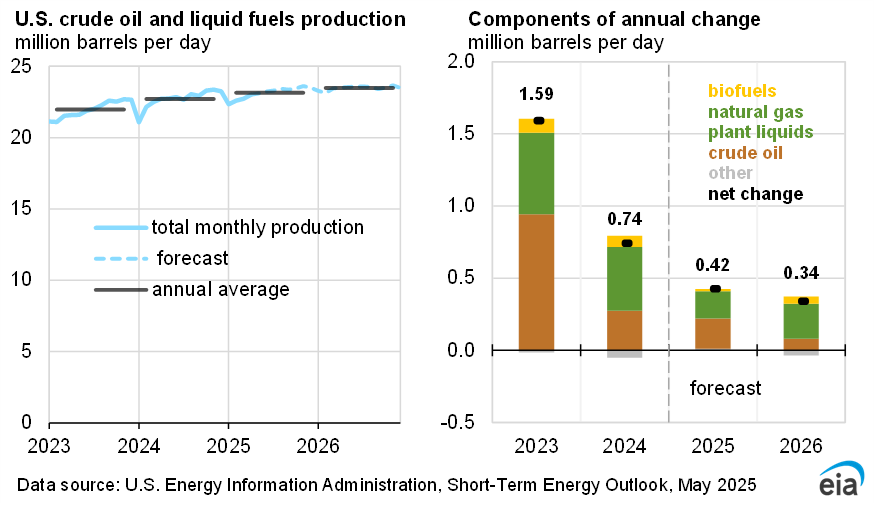
U.S. crude oil and liquid fuels production, Short-Term Energy Outlook, U.S. Energy Information Administration (June 2018), https://www.eia.gov/outlooks/steo/images/fig13.png
Oil: Crude and Petroleum Products Explained, Oil Imports and Exports, updated May 29, 2019
AEO 2019
research reportNot linked to a paper · fn 2712
U.S. Trade in Goods and Services—Balance of Payments (BOP) Basis, June 6, 2019
Leiby, Paul 2013 paper on oil import reduction (as cited in Draft TAR, 2016, Chapter 10, Endnote 39)
otherNot linked to a paper · fn 2710
Hu, S., S. Fruin, K. Kozawa, S. Mara, S.E. Paulson, and A.M. Winer. A Wide Area of Air Pollutant Impact Downwind of a Freeway during Pre-sunrise Hours. Atmospheric Environment. 43(16):2541-49 (2009). doi:10.1016/j.atmosenv.2009.02.033.
Hu, S., S.E. Paulson, S. Fruin, K. Kozawa, S. Mara, and A.M. Winer. Observation of Elevated Air Pollutant Concentrations in a Residential Neighborhood of Los Angeles California Using a Mobile Platform. Atmospheric Environment. 51:311-319 (2012). doi:10.1016/j.atmosenv.2011.12.055.
Pukkala, E. Cancer incidence among Finnish oil refinery workers, 1971-1994. Journal of Occupational and Environmental Medicine. 40(8):675-79 (1998). doi:10.1023/A:1018474919807.
Chan, C.-C.; Shie, R.H.; Chang, T.Y.; Tsai, D.H. Workers' exposures and potential health risks to air toxics in a petrochemical complex assessed by improved methodology. International Archives of Occupational and Environmental Health. 79(2):135-142 (2006).
Bulka, C.; Nastoupil, L.J.; McClellan, W.; et al. Residence proximity to benzene release sites is associated with increased incidence of non-Hodgkin lymphoma. Cancer. 119(18):3309-17 (2013).
HEI (Health Effects Institute). 2010. Traffic-Related Air Pollution: A Critical Review of the Literature on Emissions, Exposure and Health Effects. Special Report 17.
Heinrich, J. and H.-E. Wichmann. 2004. Traffic Related Pollutants in Europe and their Effect on Allergic Disease. Current Opinion in Allergy and Clinical Immunology 4(5):341-348.
Salam, M.T., T. Islam, and F.D. Gilliland. 2008. Recent Evidence for Adverse Effects of Residential Proximity to Traffic Sources on Asthma. Current Opinion in Pulmonary Medicine 14(1):3-8.
Samet, J.M. 2007. Traffic, Air Pollution, and Health. Inhalation Toxicology 19(12):1021-27.
Adar, S. and J. Kaufman. 2007. Cardiovascular Disease and Air Pollutants: Evaluating and Improving Epidemiological Data Implicating Traffic Exposure. Inhalation Toxicology 19(S1):135-49.
Wilker, E.H., E. Mostofsky, S.H. Lue, et al. 2013. Residential Proximity to High-Traffic Roadways and Poststroke Mortality. Journal of Stroke and Cerebrovascular Diseases 22(8): e366-e372.
Hart, J.E., E.B. Rimm, K.M. Rexrode, and F. Laden. 2013. Changes in Traffic Exposure and the Risk of Incident Myocardial Infarction and All-cause Mortality. Epidemiology 24(5):734-42.
U.S. Global Change Research Program (GCRP). Global Climate Change Impacts in the United States: The Third National Climate Assessment. 841 pp (2014). doi:10.7930/J0Z31WJ2.
GCRP. The Impacts of Climate Change on Human Health in the United States, A Scientific Assessment (2016). April 2016.
Mohai, P., P.M. Lantz, J. Morenoff, J.S. House, and R.P. Mero. Racial and Socioeconomic Disparities in Residential Proximity to Polluting Industrial Facilities: Evidence from the Americans' Changing Lives Study. American Journal of Public Health 99(S3): S649-S656 (2009).
For example, one study found that survey respondents who were black and, to a lesser degree, had lower income levels, were significantly more likely to live within 1 mile of an industrial facility listed in the EPA's 1987 Toxic Release Inventory (TRI) national database.\3542\ --------------------------------------------------------------------------- ---------------------------------------------------------------------------
Ringquist, E.J. Evidence of Environmental Inequities: A Meta-Analysis. Journal of Policy Analysis and Management 24(2):223-47 (2005).
A meta-analysis of 49 environmental equity studies concluded that evidence of race-based environmental inequities is statistically significant (although the average magnitude of these inequities is small), while evidence supporting the existence of income-based environmental inequities is substantially weaker.\3543\ Considering poverty-based class effects, that meta-
Sicotte, D. and S. Swanson. Whose Risk in Philadelphia? Proximity to Unequally Hazardous Industrial Facilities. Social Science Quarterly 88(2):516-534 (2007).
To test whether there are disparate impacts from hazardous industrial facilities on racial/ethnic minorities, the disadvantaged, the working class, and manufacturing workers, one study tested the relationship between hazard scores of Philadelphia-area facilities in EPA's Risk-Screening Environmental Indicators (RSEI) database and the demographics of populations near those facilities using multivariate regression.\3545\ This study concluded that racial/ethnic minorities, the most socioeconomically disadvantaged, and those employed in manufacturing suffer a disparate impact from the highest-hazard facilities (primarily manufacturing plants). --------------------------------------------------------------------------- ---------------------------------------------------------------------------
O'Rourke, D. and S. Connolly. Just Oil? The Distribution of Environmental and Social Impacts of Oil Production and Consumption. Annual Review of Environment and Resources 28(1):587-617 (2003).
One study found that the populations surrounding oil refineries are more often minorities, concluding that ``56 percent of people living within three miles of [oil] refineries in the United States are minorities--almost double the national average.'' \3550\ Another examined whether findings of environmental inequity varied between coke production plants and oil refineries, both of which are significant sources of air pollution.\3551\ This study concluded that census tracts near coke plants had a disproportionate share of poor and nonwhite residents, and that existing inequities were primarily economic in nature.
Graham, J.D., N.D. Beaulieu, D. Sussman, M. Sadowitz, and Y.C. Li. Who Lives Near Coke Plants and Oil Refineries? An Exploration of the Environmental Inequity Hypothesis. Risk Analysis 19(2):171-86 (1999).
One study found that the populations surrounding oil refineries are more often minorities, concluding that ``56 percent of people living within three miles of [oil] refineries in the United States are minorities--almost double the national average.'' \3550\ Another examined whether findings of environmental inequity varied between coke production plants and oil refineries, both of which are significant sources of air pollution.\3551\ This study concluded that census tracts near coke plants had a disproportionate share of poor and nonwhite residents, and that existing inequities were primarily economic in nature.
Carpenter, A. and M. Wagner. Environmental Justice in the Oil Refinery Industry: A Panel Analysis Across United States Counties. Ecological Economics 159:101-109 (2019).
A more recent study of environmental justice in the oil refinery industry found evidence of environmental injustice as a result of unemployment levels in areas around refineries and, to a slightly lesser extent, as a result of income inequality.\3552\ This study did not test for race-based environmental inequities. --------------------------------------------------------------------------- ---------------------------------------------------------------------------
Green, R.S., S. Smorodinsky, J.J. Kim, R. McLaughlin, and B. Ostro. Proximity of California public schools to busy roads. Environmental Health Perspectives 112(1):61-66 (2004).
Kingsley, S.L., M.N. Eliot, L. Carlson, et al. Proximity of US Schools to Major Roadways: A Nationwide Assessment. Journal of Exposure Science and Environmental Epidemiology 24(3):253-59 (2014).
Fewer studies have been conducted at the national level, yet those that do exist also demonstrate a correlation between minority and low- income status and proximity to roadways.3568 3569 For example, one study found that greater traffic volumes and densities at the national level are associated with larger shares of minority and low-income populations living in the vicinity.\3570\ Another study found that schools with minority and underprivileged \3571\ children were disproportionately located within 250 meters of a major roadway.\3572\ --------------------------------------------------------------------------- ---------------------------------------------------------------------------
Rowangould, G.M. A Census of the US Near-roadway Population: Public Health and Environmental Justice Considerations. Transportation Research Part D 25:59-67 (2013).
Fewer studies have been conducted at the national level, yet those that do exist also demonstrate a correlation between minority and low- income status and proximity to roadways.3568 3569 For example, one study found that greater traffic volumes and densities at the national level are associated with larger shares of minority and low-income populations living in the vicinity.\3570\ Another study found that schools with minority and underprivileged \3571\ children were disproportionately located within 250 meters of a major roadway.\3572\ --------------------------------------------------------------------------- ---------------------------------------------------------------------------
Maldonado, J., C. Shearer, R. Bronen, K. Peterson, and H. Lazrus. The Impact of Climate Change on Tribal Communities in the US: Displacement, Relocation, and Human Rights. Climatic Change 120(3):601-14 (2013).
American tribes and Alaskan Native villages are also more susceptible to the impacts of climate change, as these groups often disproportionately rely on natural resources for livelihoods, medicines, and cultural and spiritual purposes.\3594\ Moreover, coastal tribal communities may have to relocate because of sea-level rise, erosion, and permafrost thaw.\3595\ NHTSA's FEIS provides additional discussion of health and societal impacts of climate change on indigenous communities in Section 8.6.5.2, Sectoral Impacts of Climate Change, under Human Health and Human Security. --------------------------------------------------------------------------- ---------------------------------------------------------------------------
Knowlton, K., B. Lynn, R.A. Goldberg, et al. Projecting Heat-related Mortality Impacts under a Changing Climate in the New York City Region. American Journal of Public Health 97(11):2028-34 (2007).
O'Neill, M.S., M. Jerrett, I. Kawachi, et al. Health, Wealth, and Air Pollution: Advancing Theory and Methods. Environmental Health Perspectives 111(16):1861-70 (2003).
Finkelstein, M.M.; Jerrett, M.; DeLuca, P.; et al. Relation between income, air pollution and mortality: a cohort study. Canadian Med Assn J 169: 397-402 (2003).
O'Neill, M.S., A. Zanobetti, and J. Schwartz. Disparities by Race in Heat-Related Mortality in Four US Cities: The Role of Air Conditioning Prevalence. Journal of Urban Health 82(2):191-97 (2005).
Harlan, S.L. and D.M. Ruddell. Climate Change and Health in Cities: Impacts of Heat and Air Pollution and Potential Co-Benefits from Mitigation and Adaptation. Current Opinion in Environmental Sustainability 3(3):126-34 (2011).
Center for Biological Diversity, Sierra Club, and Public Citizen, Inc., Docket No. NHTSA-2018-0067-12378, at 25-30.
otherNot linked to a paper · fn 3508
2018 EPA Automotive Trends Report at Figures 5.15 and 5.17.
research reportNot linked to a paper · fn 2491
EPA Greenhouse Gas Emission Standards for Light-Duty Vehicles: Manufacturer Performance Report for the 2016 Model Year. EPA-420-R-18-002. January 2019.
government reportNot linked to a paper · fn 2492
Short Term Energy Outlook November 2019, available at https://www.eia.gov/outlooks/steo/archives/nov19.pdf
Wards Auto Monthly Sales reports, available at https://wardsintelligence.informa.com/
Bordoff, EPA-HQ-OAR-2018-0283-3906
otherNot linked to a paper · Need of the United States To Conserve Energy, consumer costs and fuel prices
Ilya Arkhipov, Will Kennedy, Olga Tanas, and Grant Smith, "Putin Dumps MBS to Start a War on America's Shale Oil Industry," March 7, 2020, Bloomberg News
Pihl, Josh A., et al., "Development of a Cold Start Fuel Penalty Metric for Evaluating the Impact of Fuel Composition Changes on SI Engine Emissions Control," Oak Ridge National Laboratory, 2018.
The additional fuel that must be used to heat the catalyst is typically referred to as a ``cold-start penalty,'' meaning that vehicle's fuel economy (over a test cycle) is reduced because the fuel consumed to heat the catalyst did not go toward the goal of moving the vehicle forward.\2671\ The Autonomie
Synapse Energy Economics, Inc., "Cleaner Cars and Job Creation"
research reportNot linked to a paper · Consideration of Economic Practicability (job impacts)
Bloomberg New Energy Finance, “Electric Vehicle Outlook: 2018,” https://bnef.turtl.co/story/evo2018?teaser=true
Fred Lambert, “Tesla to achieve leading $100/kWh battery cell cost this year, says investor after Gigafactory 1 tour” (Sept. 11, 2018), https://electrek.co/2018/09/11/tesla-100-kwh-battery-cost-investor-gigafactory-1-tour/