Medicare Program; Hospital Inpatient Prospective Payment Systems for Acute Care Hospitals and the Long-Term Care Hospital Prospective Payment System and Proposed Policy Changes and Fiscal Year 2023 Rates; Quality Programs and Medicare Promoting Interoperability Program Requirements for Eligible Hospitals and Critical Access Hospitals; Costs Incurred for Qualified and Non-Qualified Deferred Compensation Plans; and Changes to Hospital and Critical Access Hospital Conditions of Participation
Federal Register2022-05-10 · DEPARTMENT OF HEALTH AND HUMAN SERVICES; Centers for Medicare & Medicaid Services · Proposed Rule · 2022-08268
Proposed rule.
This proposed rule would: Revise the Medicare hospital inpatient prospective payment systems (IPPS) for operating and capital- related costs of acute care hospitals; make changes relating to Medicare graduate medical education (GME) for teaching hospitals; update the payment policies and the annual payment rates for the Medicare prospective payment system (PPS) for inpatient hospital services provided by long-term care hospitals (LTCHs). In additon it would establish new requirements and revise existing requirements for eligible hospitals and critical access hospitals (CAHs) participating in the Medicare Promoting Interoperability Program; provide estimated and newly established performance standards for the Hospital Value- Based Purchasing (VBP) Program; and propose updated policies for the Hospital Readmissions Reduction Program, Hospital Inpatient Quality Reporting (IQR) Program, Hospital VBP Program, Hospital-Acquired Condition (HAC) Reduction Program, PPS-Exempt Cancer Hospital Reporting (PCHQR) Program, and the Long-Term Care Hospital Quality Reporting Program (LTCH QRP). It would also revise the hospital and critical access hospital (CAH) conditions of participation (CoPs) for infection prevention and control and antibiotic stewardship programs; and codify and clarify policies related to the costs incurred for qualified and non-qualified deferred compensation plans. Lastly, this proposed rule would provide updates on the Rural Community Hospital Demonstration Program and the Frontier Community Health Integration Project.
Original sourceXML (4.1 MB)PDF (20.2 MB)
Other documents for the same rulemaking (all, by stage)
References: 265 extracted, 203 linked to papers
Page 2Download these results: CSV · JSON
CMS Data Element Library Fact Sheet. Available at: https://www.cms.gov/newsroom/fact-sheets/cms-data-element-library-fact-sheet.
PACIO Project. Available at: http://pacioproject.org/about/.
HL7 FHIR. PACIO Functional Status Implementation Guide. Available at: https://paciowg.github.io/functional-status-ig/.
The Trusted Exchange Framework (TEF): Principles for Trusted Exchange (Jan. 2022).
Common Agreement for Nationwide Health Information Interoperability Version 1 (Jan. 2022).
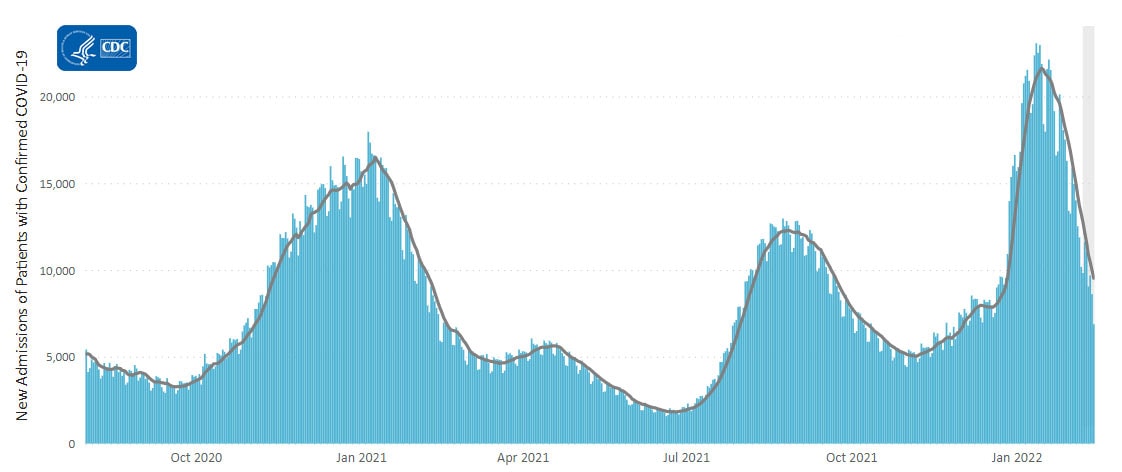
CDC hospitalization data, accessed February 22, 2022, https://www.cdc.gov/coronavirus/2019-ncov/covid-data/covidview/02182022/images/hospitalizations_02182022.jpg
Weiner-Lastinger, Lindsey M., et al. “The Impact of Coronavirus Disease 2019 (COVID-19) on Healthcare-Associated Infections in 2020: A Summary of Data Reported to the National Healthcare Safety Network.” Infection Control & Hospital Epidemiology, vol. 43, no. 1, 2022, pp. 12-25., doi:10.1017/ice.2021.362.
Rates of AR infections have increased in healthcare settings since the beginning of the COVID-19 pandemic, reversing previous prevention successes such as declines of AR infections by as much as 30 percent prior to the pandemic.\1423\ Additionally, Methicillin-resistant Staphylococcus aureus (MRSA) infections increased five consecutive quarters from 2020 to 2021, including some quarter over quarter increases of 39 percent.\1424\ Strengthening of infection prevention and control and antibiotic stewardship is needed to address these challenges and ensure a solid foundation for future public health emergencies. --------------------------------------------------------------------------- ---------------------------------------------------------------------------
Sun M, Oliwa T, Peek ME, Tung EL. Negative Patient Descriptors: Documenting Racial Bias in the Electronic Health Record. Health Affairs 41, No. 2 (2022): 203-211. doi:10.1377/hlthaff.2021.01423.
wing patients to add information to their records be useful in promoting patient access and utilization? Are there other incentives that would promote patient access? ++ Are there potential unintended consequences in allowing patients to add information to their records? What could be done to mitigate any potential unintended consequences? ++ Are there certain tools found to be useful in promoting patient access and use of their health information? Recent studies have raised concerns about the presence of racial bias and stigmatizing language within EHRs that could lead to unintended consequences if patients were to obtain disparaging notes regarding their medical care.\1441\ \1442\ --------------------------------------------------------------------------- ---------------------------------------------------------------------------
Himmelstein G, Bates D, Zhou L. Examination of Stigmatizing Language in the Electronic Health Record. JAMA Netw Open. 2022;5(1):e2144967. doi:10.1001/jamanetworkopen.2021.44967.
tients to add information to their records be useful in promoting patient access and utilization? Are there other incentives that would promote patient access? ++ Are there potential unintended consequences in allowing patients to add information to their records? What could be done to mitigate any potential unintended consequences? ++ Are there certain tools found to be useful in promoting patient access and use of their health information? Recent studies have raised concerns about the presence of racial bias and stigmatizing language within EHRs that could lead to unintended consequences if patients were to obtain disparaging notes regarding their medical care.\1441\ \1442\ --------------------------------------------------------------------------- ---------------------------------------------------------------------------
Turner K, Clary A, Hong Y, Alishahi Tabriz A, Shea CM. Patient Portal Barriers and Group Differences: Cross-Sectional National Survey Study. J Med internet Res 2020;22(9):e18870.
++ What policy, implementation strategies, or other considerations are necessary to address existing racial bias or other biases and prevent use of stigmatizing language? Additional analysis of HINTS data provides insights into common barriers to patient portal access and use as well as characteristics that can help predict which individuals are more likely to experience certain barriers (for example, preference for in-person communication with their provider is one of the most prevalent barriers experienced more often by older adults and women).\1443\ --------------------------------------------------------------------------- ---------------------------------------------------------------------------
Henry J, Barker W, Kachay L. Office of the National Coordinator for Health Information Technology (ONC) Data Brief No. 45 (April 2019). Electronic Capabilities for Patient Engagement among U.S. Non-Federal Acute Care Hospitals: 2013-2017.
benefits such as improvements in access, quality of care, and health outcomes, and reductions in healthcare expenditures.\1434\ In particular, access to health information has been shown to enable the discovery of medical errors, to improve medication adherence, and to promote communication between the patient and health care provider.\1435\ However, despite the fact that surveyed patients experiencing shared access to notes with health care providers has been largely positive,\1436\ voluntary uptake and use of patient portals has been low, with nearly two-thirds of hospitals having less than 25 percent of patients activate access to the hospital's patient portal in 2017.\1437\ Health care provider encouragement (and other facilitating conditions), perceived usefulness, ease of use, control of health information, and enhanced communication are demonstrated as facilitators, while concerns of privacy, security, and lack of awareness have been tied to barriers of use.1438 1439 -----------
Johnson C, Richwine C, Patel V. Office of the National Coordinator for Health Information Technology (ONC) Data Brief, No. 57 (September 2021). Individuals' Access and Use of Patient Portals and Smartphone Health Apps, 2020.
The HINTS results showed the rates of individuals being offered and subsequently using their health information through a patient portal, as well as use of mobile health applications (apps) and the role health care providers play in encouraging use.\1440\ Results showed that health care providers and staff have a substantial role in influencing patient use of the portal. --------------------------------------------------------------------------- ---------------------------------------------------------------------------
CDC. Antibiotic Resistance Threats in the United States, 2019. Atlanta, GA: U.S. Department of Health and Human Services, CDC; 2019.
difficile (an opportunistic pathogen associated with antimicrobial use), and nearly 50,000 people die.\1421\ As more pathogens become resistant to available antimicrobials, options for reliably and rapidly treating infections--including pneumonias, foodborne illnesses, and healthcare- associated infections--become increasingly limited, more expensive and, in some cases, nonexistent.
CDC. Antibiotic Use in the United States, 2018 Update: Progress and Opportunities. Atlanta, GA: U.S. Department of Health and Human Services, CDC; 2019.
research reportNot linked to a paper · fn 1422
CDC. 2020 National and State Healthcare-Associated Infections Progress Report. Atlanta, GA: U.S. Department of Health and Human Services, CDC; 2021.
Rates of AR infections have increased in healthcare settings since the beginning of the COVID-19 pandemic, reversing previous prevention successes such as declines of AR infections by as much as 30 percent prior to the pandemic.\1423\ Additionally, Methicillin-resistant Staphylococcus aureus (MRSA) infections increased five consecutive quarters from 2020 to 2021, including some quarter over quarter increases of 39 percent.\1424\ Strengthening of infection prevention and control and antibiotic stewardship is needed to address these challenges and ensure a solid foundation for future public health emergencies. --------------------------------------------------------------------------- ---------------------------------------------------------------------------
Michaels D., Emanuel EJ, Bright RA. A National Strategy for COVID-19: Testing, Surveillance, and Mitigation Strategies. JAMA. Published online January 06, 2022. doi:10.1001/jama.2021.24168.
public health agencies to have much more timely, complete, and consistent data for future pathogens of concern.\1449\ We believe that the proposed requirements provide a regulatory framework for the reporting of relevant infectious disease data by hospitals and CAHs with regard to future pandemics and epidemics.
Office of the Assistant Secretary for Planning and Evaluation (ASPE). (2020). National Action Plan for Combatting Antibiotic-Resistant Bacteria, 2020-2025.
Qualified Health Information Network (QHIN) Technical Framework (QTF) Version 1.0 (Jan. 2022)
FHIR® Roadmap for TEFCA Exchange Version 1 (Jan. 2022)
Maksut JL, Hodge C, Van CD, Razmi, A, & Khau MT. Utilization of Z Codes for Social Determinants of Health among Medicare Fee-For-Service Beneficiaries, 2019. Office of Minority Health (OMH) Data Highlight No. 24. Centers for Medicare & Medicaid Services (CMS), Baltimore, MD, 2021.
research reportNot linked to a paper · fn 13
Truong HP, Luke AA, Hammond G, Wadhera RK, Reidhead M, Joynt Maddox KE. Utilization of Social Determinants of Health ICD-10 Z-Codes Among Hospitalized Patients in the United States, 2016-2017. Med Care. 2020;58(12):1037-1043. doi:10.1097/MLR.0000000000001418.
Wark K, Cheung K, Wolter E, Avey JP. Engaging stakeholders in integrating social determinants of health into electronic health records: A scoping review. International Journal of Circumpolar Health. 2021 Jan 1;80(1):1943983.
Garg A, Boynton-Jarrett R, Dworkin PH. Avoiding the Unintended Consequences of Screening for Social Determinants of Health. JAMA. 2016;316(8):813-814. doi:10.1001/jama.2016.9282
Providers may or may not be able to reliably document certain circumstances,\16\ as a result, in the medical records.
Egede LE, Walker RJ, Williams JS. Intersection of Structural Racism, Social Determinants of Health, and Implicit Bias With Emergency Physician Admission Tendencies. JAMA Netw Open. 2021;4(9):e2126375. doi:10.1001/jamanetworkopen.2021.26375
There are also questions of how bias can play into screening for SDOH and how systemic bias within the health care system can play a role in this process.\17\ CMS has also heard of the significant pressures on provider time, and whether providers have access to comprehensive care and coordination teams, including social workers, who may be more appropriately skilled to assess certain SDOH. --------------------------------------------------------------------------- ---------------------------------------------------------------------------
Commission on Social Determinants of Health. Closing the gap in a generation: Health equity through action on the social determinants of health: Final report of the commission on social determinants of health. World Health Organization, 2008.
Given that SDOH diagnosis codes describe economic and environmental circumstances faced by patients and often correlate with substantial variance in health outcomes,\18\ more widely adopted consistent documentation and reporting in the inpatient setting could better identify non-medical factors affecting health and track progress toward addressing them.
Koh HK, O'Connell JJ. Improving Health Care for Homeless People. JAMA. 2016;316(24):2586-2587. doi:10.1001/jama.2016.18760.
Homelessness can be reasonably expected to have an impact on hospital utilization.\19\ Healthcare needs for patients experiencing homelessness may be associated with increased resource utilization compared to other patients due to difficulty finding discharge destinations to meet the patient's multifaceted needs which can result in longer inpatient stays and can have financial impacts for hospitals.\20\ Longer hospital stays for these patients \21\ can also be associated with increased costs because patients experiencing homelessness are less able to access care at early stages of illness, and also may be exposed to communicable disease and harsh climate conditions, resulting in more severe and complex symptoms by the time they are admitted to hospitals, potentially
Canham SL, Custodio K, Mauboules C, Good C, Bosma H. Health and Psychosocial Needs of Older Adults Who Are Experiencing Homelessness Following Hospital Discharge. Gerontologist. 2020 May 15;60(4):715-724. doi: 10.1093/geront/gnz078. PMID: 31228238.
Homelessness can be reasonably expected to have an impact on hospital utilization.\19\ Healthcare needs for patients experiencing homelessness may be associated with increased resource utilization compared to other patients due to difficulty finding discharge destinations to meet the patient's multifaceted needs which can result in longer inpatient stays and can have financial impacts for hospitals.\20\ Longer hospital stays for these patients \21\ can also be associated with increased costs because patients experiencing homelessness are less able to access care at early stages of illness, and also may be exposed to communicable disease and harsh climate conditions, resulting in more severe and complex symptoms by the time they are admitted to hospitals, potentially leading to worse health outcomes.
Hwang SW, Weaver J, Aubry T. Hospital costs and length of stay among homeless patients admitted to medical, surgical, and psychiatric services. Med Care. 2011;49:350-354.
Homelessness can be reasonably expected to have an impact on hospital utilization.\19\ Healthcare needs for patients experiencing homelessness may be associated with increased resource utilization compared to other patients due to difficulty finding discharge destinations to meet the patient's multifaceted needs which can result in longer inpatient stays and can have financial impacts for hospitals.\20\ Longer hospital stays for these patients \21\ can also be associated with increased costs because patients experiencing homelessness are less able to access care at early stages of illness, and also may be exposed to communicable disease and harsh climate conditions, resulting in more severe and complex symptoms by the time they are admitted to hospitals, potentially leading to worse health outcomes.
Sun R (AHRQ), Karaca Z (AHRQ), Wong HS (AHRQ). Characteristics of Homeless Individuals Using Emergency Department Services in 2014. HCUP Statistical Brief #229. October 2017. Agency for Healthcare Research and Quality, Rockville, MD.
In addition, patients experiencing homelessness may have limited or no access to prescription medicines or over-the-counter medicines, including adequate locations to store medications away from the heat or cold,\22\ and studies have shown difficulties adhering to medication regimens among persons experiencing homeless.\23\ Patients experiencing homelessness may also face challenges in accessing transplants and clinicians may defer care because of the uncertain post-acute discharge. --------------------------------------------------------------------------- ---------------------------------------------------------------------------
Coe, Antoinette B. Coe et al. "Medication Adherence Challenges Among Patients Experiencing Homelessness in a Behavioral Health Clinic.
In addition, patients experiencing homelessness may have limited or no access to prescription medicines or over-the-counter medicines, including adequate locations to store medications away from the heat or cold,\22\ and studies have shown difficulties adhering to medication regimens among persons experiencing homeless.\23\ Patients experiencing homelessness may also face challenges in accessing transplants and clinicians may defer care because of the uncertain post-acute discharge. --------------------------------------------------------------------------- ---------------------------------------------------------------------------
Centers for Medicare & Medicaid Services. (2021). Building an Organizational Response to Health Disparities [Fact Sheet]. U.S. Department of Health and Human Services. Available at: https://www.cms.gov/About-CMS/Agency-Information/OMH/Downloads/Health-Disparities-Guide.pdf.
Centers for Medicare & Medicaid Services. (2021). Meaningful Measures 2.0: Moving from Measure Reduction to Modernization.
Centers for Medicare & Medicaid Services. (2021). List of Measures Under Consideration for December 1, 2021.
National Quality Forum. (2021). Measure Applications Partnership Rural Health Advisory Group Virtual Review Meeting: Meeting Summary for December 8, 2021.
Baker, M.C., Alberti, P.M., Tsao, T.Y., Fluegge, K., Howland, R.E., & Haberman, M. (2021). Social Determinants Matter for Hospital Readmission Policy: Insights From New York City. Health Affairs, 40(4), 645-654.
Hammond, G., Johnston, K., Huang, K., Joynt Maddox, K. (2020). Social Determinants of Health Improve Predictive Accuracy of Clinical Risk Models for Cardiovascular Hospitalization, Annual Cost, and Death. Circulation: Cardiovascular Quality and Outcomes, 13 (6) 290-299.
Billioux, A., Verlander, K., Anthony, S., & Alley, D. (2017). Standardized Screening for Health-Related Social Needs in Clinical Settings: The Accountable Health Communities Screening Tool. NAM Perspectives, 7(5).
Osterman, M.J.K., Martin, J.A. (2014). Trends in Low-risk Cesarean Delivery in the United States, 1990-2013. National Vital Statistics Reports, 63(6): 1-16.
since the 1990s.\960\ C-sections accounted for 31.8 percent of U.S.
Hamilton, B.E., Martin, J.A., Osterman, M.J.K. (2020). Births: Provisional Data for 2020. National Vital Statistics Rapid Release, no 12.
live births in 2020,\961\ and there is a considerable amount of variation in the rates based on U.S.
Kozhimannil, K.B., Law, M.R. & Virnig, B.A. (2013). Cesarean delivery rates vary tenfold among US hospitals; reducing variation may address quality and cost issues. Health Affairs, 32(3): 527-35.
region, state, and healthcare institution.\962\ There is also substantial variability across races and ethnicities; the rate of C-sections is: 30.8 percent among Non- Hispanic White women, 36.3 percent among Black women, 28.8 percent among American Indian or Alaska Native women, 32.6 among Asian women, and 31.4 percent among Hispanic women.\963\ U.S.
Caughey AB, Cahill AG, Guise JM, Rouse DJ. (2014). Safe prevention of the primary cesarean delivery. Am J Obstet Gynecol. 2014 Mar;210(3):179-93.
Curtin, S.C., Gregory, K.D., Korst, L.M., Uddin, S.F.G. (2015) Maternal Morbidity for Vaginal and Cesarean Deliveries, According to Previous Cesarean History: New Data from the Birth Certificate, 2013. National Vital Statistics Reports. Volume 64, Number 4.
However, non-Hispanic Black women who deliver via C-section for the first time had the highest rates of uterine rupture and ICU admission compared with all other races and ethnicities.\978\ --------------------------------------------------------------------------- ---------------------------------------------------------------------------
Keag, O.E., Norman, J.E. & Stock, S.J. (2018). Long-term risks and benefits associated with cesarean delivery for mother, baby, and subsequent pregnancies: Systematic review and meta-analysis. Plos Med, 15(1): e1002494.
Main, E.K., Chang, S.C., Cape, V., Sakowski, C. Smith, H., Vasher, J. (2019) Safety Assessment of a Large-Scale Improvement Collaborative to Reduce Nulliparous Cesarean Delivery Rates. Obstetrics & Gynecology, 133(4):613-623.
Leonard, S.A., Main, E.K., Scott, K.A., Profit, J., & Carmichael, S.L. (2019). Racial and ethnic disparities in severe maternal morbidity prevalence and trends. Annals of epidemiology, 33, 30-36.
Kozhimannil, K.B., Interrante, J.D., Henning-Smith, C., & Admon, L.K. (2019). Rural-urban differences in severe maternal morbidity and mortality in the US, 2007-15. Health affairs, 38(12), 2077-2085.
This is further reflected in the Biden-Harris Administration's first ever Presidential proclamation recognizing Black Maternal Health Week.\1029\ CMS is also interested in promoting policies that ensure Americans who live in rural areas have access to high quality care, particularly in the area of maternal health where residents in rural settings have a 9 percent greater probability of SMM and mortality, compared with urban residents.\1030\ Ultimately, driving the development and execution of evidence-based best practices in maternity care, improving overall maternal health, and closing the racial and ethnic disparity gaps in outcomes are among our agency's top healthcare quality and safety goals.\1031\ --------------------------------------------------------------------------- ---------------------------------------------------------------------------
Lee LA, Caplan RA, Stephens LS, et al. Postoperative opioid-induced respiratory depression: A closed claims analysis. Anesthesiology. 2015;122(3):659-665.
Most opioid-related adverse events are preventable.\1061\ Of the opioid-related adverse drug events reported to The Joint Commission's Sentinel Event database, 47 percent were due to a wrong medication dose, 29 percent due to improper monitoring, and 11 percent due to other causes (for example, medication interactions and/or drug reactions).\1062\ In addition, in a review of cases from a malpractice claims database in which there was opioid-induced respiratory depression among post-operative surgical patients, 97 percent of these adverse events were judged preventable with better monitoring and response.\1063\ --------------------------------------------------------------------------- ----------------------------------------------------
Dahan A, Aarts L, Smith TW. (2010). Incidence, Reversal, and Prevention of Opioid-induced Respiratory Depression. Anesthesiology. 112(1):226-238.
Census Bureau's website at https://www.census.gov/programs-surveys/geography/technical-documentation/county-changes.2010.html
Office of the Actuary's January 2022 Medicare DSH estimates (Office of the Actuary, Centers for Medicare & Medicaid Services)
research reportNot linked to a paper · Section IV.D.1 (Proposed Calculation of Factor 1)